
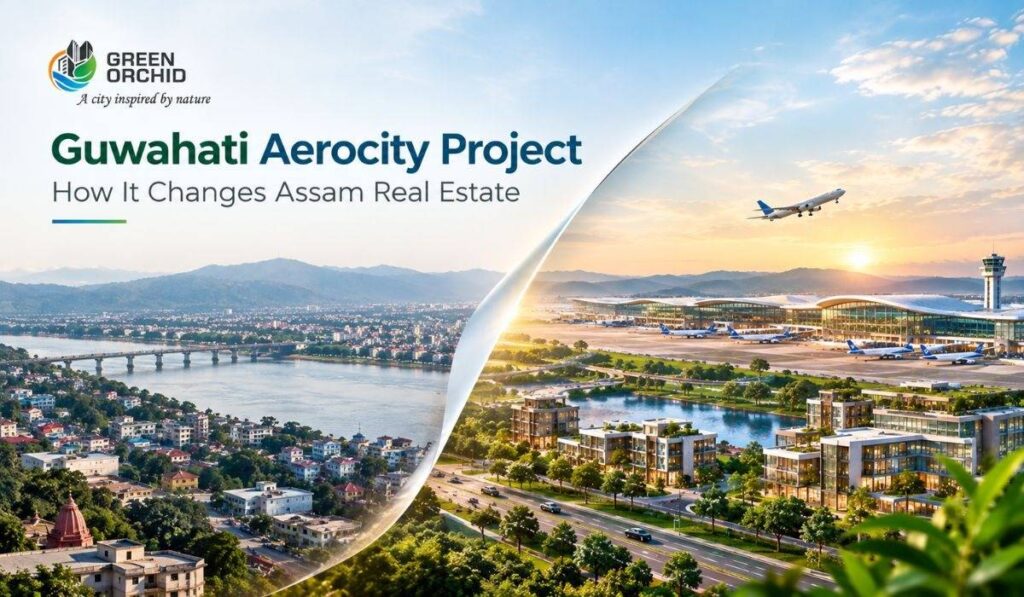
The Guwahati Aerocity project is a planned satellite city around Lokpriya Gopinath Bordoloi International Airport (LGBIA). It is backed by a ₹2,100 crore state budget allocation and modeled on the “aerotropolis” concept already used in Noida, Gurugram, and New Town Kolkata. It is already reshaping property demand and pricing in Guwahati, especially in airport-corridor areas like Dharapur, Azara, and Garchuk. Here are five reasons this project stands to change Assam real estate market.
What is the Guwahati Aerocity Project?
The Assam government announced the Aerotropolis (Aerocity) in its 2026–27 state budget, describing it as a modern satellite city planned around Guwahati Airport. The government has allocated ₹2,100 crore for land acquisition and development of the project.
The initiative aims to support planned urban growth and strengthen the airport corridor as a centre for business, housing and infrastructure. The idea is to make the airport more than a place for flights by creating a connected economic and urban zone around it. This zone will include:
- Offices and business districts
- Logistics and industrial parks
- Hotels
- Educational institutions
- Residential townships
Key facts about the project:
- The state has set up the Guwahati Satellite City Development Authority (GSCDA) to run the project. It is a special purpose vehicle fully owned by the Assam government.
- Finance Minister Jayanta Mallabaruah compared the plan to Noida (UP), Gurugram (Haryana), and New Town Kolkata (West Bengal). These are well-known Indian satellite cities built around infrastructure hubs.
- LGBIA is operated by the Adani Group.
- A new international terminal is under construction as part of the airport’s expansion.
- The airport won an international architectural award in 2025 for a design inspired by Northeast India’s culture and landscape.
5 Reasons Guwahati Aerocity Will Transform Assam’s Real Estate Market
1. Real Money Is Already Behind It
Many mega projects in India stay on paper for years. This one is different. The state has set aside ₹2,100 crore specifically for land acquisition. This is not a feasibility study. It is the first real step of implementation.
What this means on the ground:
- Land acquisition notices have gone out for more than 400 bighas across Azara, Garal, and Mirzapur villages.
- Reports suggest the full Aerotropolis footprint could eventually reach around 6,000 bighas.
- When a government moves from policy talk to actual land notices, real estate markets tend to react. That reaction is already visible in Guwahati price data.
2. The Aerotropolis Model Already Works Elsewhere in India
This is not a new or untested idea. The “airport city” model has already succeeded in other Indian markets.
- Worldmark Aerocity, Delhi: Built around Indira Gandhi International Airport. It has grown into a 7-million-sq-ft hub of offices, retail, and hospitality. It is now backed by major investors like Brookfield.
- Bengaluru: Similar aerotropolis-style development exists near Kempegowda Airport.
- Mohali: A comparable airport-city project has developed near Chandigarh airport.
The pattern repeats every time: land near an airport starts out cheap and semi-rural. Once connectivity, logistics demand, and business travel arrive, it becomes valuable commercial and residential land.
Guwahati is the main aviation gateway to Northeast India. It is a strong candidate to follow the same growth curve, and its lower starting prices give it more room to grow.
3. Nearby Areas Are Already Seeing Price Growth
The Aerocity does not need to be fully built for its effect to show up in prices. Infrastructure projects usually push up nearby land values years before construction finishes. Guwahati is showing this pattern clearly.
Three-year price appreciation in airport-corridor localities:
- Kahikuchi: over 31%
- Dharapur: around 26%
- Garchuk: around 25%
- Azara (inside the Aerocity land zone): over 23%
- Khanapara: close to 20%
Other key numbers:
- Citywide average residential appreciation between 2020 and early 2026 is around 35–40%.
- The airport corridor (Dharapur, Azara) and the South Guwahati belt (Garchuk, Lokhra) are the fastest-moving zones in the city over the last three years.
This is not speculation. This is what current transaction data already shows.
4. Office and Commercial Demand Is Rising Too
Home prices follow jobs and business activity. Guwahati’s commercial market is expanding fast:
- A December 2025 JLL report projects Guwahati’s office stock will grow 80%, from about 2 million sq ft (2024) to 3.6 million sq ft by 2027.
- Retail vacancy is declining.
- Industrial space availability remains limited.
JLL described Guwahati as one of India’s most compelling real estate opportunities today, citing its location, infrastructure growth, and strong market fundamentals.
An aerotropolis is designed to speed up exactly this kind of growth by clustering offices, logistics, and retail around the airport. This means the commercial momentum already building in Guwahati could get a direct boost once the Aerocity moves forward.
5. It Links Guwahati to a Bigger Regional Growth Plan
Guwahati is not just a city. It is the administrative, trade, and logistics gateway for all of Northeast India. It is home to:
- IIT Guwahati
- Gauhati Medical College
- NLU Assam
- Dispur, the state capital
Other infrastructure projects underway alongside the Aerocity:
- NH-27 upgrades
- A Ring Road project
- Early-stage metro rail planning
Together, these make the Aerocity one part of a much larger connectivity push, not a standalone bet.
Industry estimates suggest:
- Emerging Guwahati localities could see 25–35% cumulative appreciation over the next few years.
- Established central zones may grow a steadier 8–12% annually.
Airport-corridor real estate sits between both trends. It is still “emerging” in price terms, but it is backed by infrastructure spending usually seen only in established metros.
Guwahati Airport Area: Township and Real Estate Projects
The area immediately around LGBIA covers Azara, Garal, Mirzapur, Borjhar, and Dharapur. This is where the on-ground impact is most visible right now.
- Azara: Sits at the center of the current land acquisition zone. It has already posted double-digit price appreciation over the last three years, even before the Aerocity was built.
- Dharapur: Currently the city’s fastest-appreciating locality overall. New mid-rise apartment launches and improving road access are the main drivers.
- Borjhar: Close to the airport itself. NH-27 connectivity improvements have made it far more investable over the past five years.
- Garchuk and Lokhra: Part of the South Guwahati belt. Local builders are launching gated residential projects here, betting on long-term end-user demand.
The growing interest in the Guwahati Airport corridor is also reflected in the development of planned residential communities in the area. Green Orchid NE is developing a residential township here, with villas, modern amenities, green spaces, and planned infrastructure. This reflects how developers are responding to increasing interest in well-connected residential locations around key growth corridors.
Challenges to Know Before You Invest
This project also has real friction on the ground, and it is worth knowing about.
- Over 1,100 families across Azara, Garal, and Mirzapur have received eviction notices. Some of this land has been held by the same families for nearly 200 years.
- Local leaders have raised concerns about the use of the older Assam Land (Requisition and Acquisition) Act, 1964, instead of the more consultative 2013 central land acquisition law.
Questions remain about transparency in compensation and rehabilitation. - In late 2025, the Guwahati Metropolitan Development Authority briefly suspended building permits and land sales in parts of the proposed zone.
For buyers, this matters. Large land-acquisition projects in India often take longer than planned. It is worth tracking how these disputes are resolved rather than assuming a smooth rollout.
Should You Invest Near the Guwahati Aerocity Project?
If you are considering a purchase in the airport corridor, keep these basics in mind:
- Check the project’s RERA registration on the official Assam RERA portal at rera.assam.gov.in before making any payment.
- Cross-check land records through Assam’s Dharitree land record portal, especially near the notified acquisition zones.
- Treat “emerging locality” appreciation numbers as directional, not guaranteed. Early-stage growth is more volatile than established central Guwahati.
- Follow GSCDA’s official announcements for the exact Aerocity master plan boundary, rather than relying only on secondary reports.
Guwahati real estate market was already one of the fastest-appreciating markets in eastern India before the Aerocity was announced. This project adds a large, government-backed catalyst on top of trends that were already in motion. That is why serious investors are paying attention now, rather than waiting for construction to finish.
FAQ’s
1. What is the Guwahati Aerocity project?
It’s a planned satellite city (an “aerotropolis”) around Guwahati’s LGBIA airport, funded through a ₹2,100 crore state allocation and executed by the Guwahati Satellite City Development Authority (GSCDA).
2. Which localities benefit most from the Guwahati Aerocity project?
Azara, Dharapur, Garal, Mirzapur, Borjhar, and Garchuk — the areas closest to the airport and along the NH-27 corridor — are seeing the earliest and sharpest price movement.
3. Is the Guwahati Aerocity project confirmed or still a proposal?
Land acquisition has formally begun with government notices covering 400+ bighas, and budget funds have been allocated, but the project also faces active local opposition and legal/land-title disputes that could affect the timeline.
4. How much have property prices near Guwahati airport grown recently?
Airport-corridor localities like Dharapur and Kahikuchi have posted roughly 25–31% appreciation over the past three years, well above many established central Guwahati neighborhoods.
5. Is it safe to invest in property near the Aerocity zone right now?
It can be a strong long-term opportunity, but buyers should verify RERA registration, check land titles via the Dharitree portal, and stay updated on the land acquisition disputes before committing, since parts of the zone have seen building permit suspensions.


